
Does AI make engineers more productive? It’s complicated.

One question I get asked frequently now is whether AI is improving software engineering productivity. The question seems easy, but it's hard to answer. My initial thought is about all those code reviews that really wasted my time, where the author didn't even try to run the app, or they didn't even look at the pipeline to see it was red before the agent decided that "the test is wrong, I'll remove it" or, worse, it continues red because the agent decided "all is fine after all".
But, I’ve learned that venting isn’t useful. Instead, I share both how LLMs have integrated into my workflow and where they’ve failed me spectacularly. The reality is always more nuanced than the hype suggests.
Before jumping in, let’s start with the obvious: AI agents are really fast writing new code and editing existing files. I consider myself a pretty fast writer, but they are a different league. Like, Cristiano and Messi’s league. They are so incredibly fast, that they probably have a sleep in there to make it more human. They are faster than the theprimeagen, one of the fastest coders on YouTube, imagine that.
How I leverage LLMs
I use LLMs daily. I use it to brainstorm ideas, format documents, evaluate strategies, find saving opportunities, to learn new things, to get information quickly, and to code - yes, that’s right - and so much more.
Brainstorming ideas and strategies
I’ll put these two together because they are kind of similar. I like the back-and-forth with the model about what could work, what couldn’t work, and sometimes it surprises me with a different angle I didn’t consider. As it has gathered so much information, it’s like a quick validation of some ideas: you don’t need to search for information within a specific section; you can ask a broader question with the proper context, and it does the search, aggregation, and structures the information for you. Super, super helpful.
I continue to use search for more detailed information if I want to go deeper into a given topic or section, though.
Format documents/emails
I love how easy it is to format the document for easier reading and to personalize it for the audience. You can literally say, "Given this type of audience, what would be the best structure for this document?" and it will format it for you.
But what I really like is to write my thoughts, get the data points supporting my reasoning and when I have everything, I just ask it to properly format the document based on a previous document structure or for a given audience.
Learning
Oh, I love this. I can ask so many dumb questions, and it will not judge me. It will actually love the question and say, "That's an excellent question." No, it's not, but I love your enthusiasm.
But learning does require asking questions and being ok with others judging you about your question. LLMs are great for people who don't always feel comfortable asking questions for one reason or another and it gives you - often - a good explanation.
Coding
Let’s start with the fact that coding has never been the bottleneck in software engineering. That said, I use it quite often to code. I use it with different styles:
- Lead: This is the style I use the most. I do the coding myself, occasionally asking it questions or code snippets, but I just understand the idea it is trying to implement and I implement it myself.
- Collaborate: We both work on the issue; I accept some of the code and refactor other parts. We play the "I pay this round, you pay the next one" game.
- Delegate: I just let it run wild. I don't care how it does it, as long as it works. Not all the code is equally important, and I remember letting it run wild to create a tool to fix product colors. I never looked at the code. It was able to fix 90% of the problem, and for that, LLMs are AMAZING.
How I came to love AI
I started using LLMs in the browser, but the game-changer was moving to Claude Code. Giving the LLM proper context and environmental awareness is an entirely different interaction.
I really love the possibility of giving it tasks - e.g., given the last invoice from AWS, investigate quick wins to reduce the cost - and focus on other tasks. It feels like proper multitasking. Then go back to it when I have the time, understand the results, and either create an action for the agent itself or for me.
And I like the blank-canvas push it can give when you need that little kick to start building. It's truly amazing.
LLMs are such a fantastic technology; it really feels like magic.
How I came to hate AI
They say there's a fine line between love and hate, and they are not wrong. Much of what I love about LLMs makes me hate LLMs.
To start with, I CANNOT stand LinkedIn anymore. Those posts, which were already fake as hell, are now faker and written by a model, which is even worse.
But I'm pretty sure you feel the same about LinkedIn, so let's focus on my own failures and experiences.
A surprising thing I noticed is how easily my brain can turn off when using LLMs, even when I'm focused, reviewing its code, and accepting it. I have a great memory, and my brain can hold quite a lot of information about the systems I'm working on. That's one of the reasons I can design systems, but also one of the reasons I'm good at troubleshooting issues in production.
So, you can imagine my surprise (confusion?) when we had an incident in a section of the code I had worked on the previous week, and I could NOT remember the details of that part of the system.
Some studies show that this may be a thing when using LLMs, and it's called cognitive offloading.
Another trend I’ve been noticing is engineers submitting large pull requests that are only partially complete, which clearly comes from coding agents. They then rely on others to catch errors and edge cases during review, which I assume feeds back into the agent so it can fix/improve the code.
When I see this, I want to pull my hair out... and I'm bald, so imagine how angry I got when I saw this pattern.
I don't want to extend this section further, so to finalize, the last piece of the puzzle that makes me hate LLMs is the hype. I understand it's so amazing it feels like magic, but the hype causes more harm than good. It creates resistance in some people that can be a positive force in improving the LLM or the tools that leverage it.
Conclusion
Is LLM increasing the productivity of software engineers or leaders in tech? My honest opinion is I really don't think so... yet.
There are definitely activities you can do faster now. Is this doing anything I couldn't do before? No. Is it convenient? Yes. Is it faster? Sometimes. Is it faster for others? That depends on how I use it.
And this is the nuance people sometimes forget. They can go really fast with LLMs and waste everyone else's time, or they can use them appropriately; sometimes they will be faster, other times slower, but overall, the entire organisation would be slightly better off leveraging these tools.
That is the part I'd like you to take with you: if you use these tools responsibly and everyone in your organization does the same, with respect for each other's time, your organization will improve.
Use LLMs responsibly.
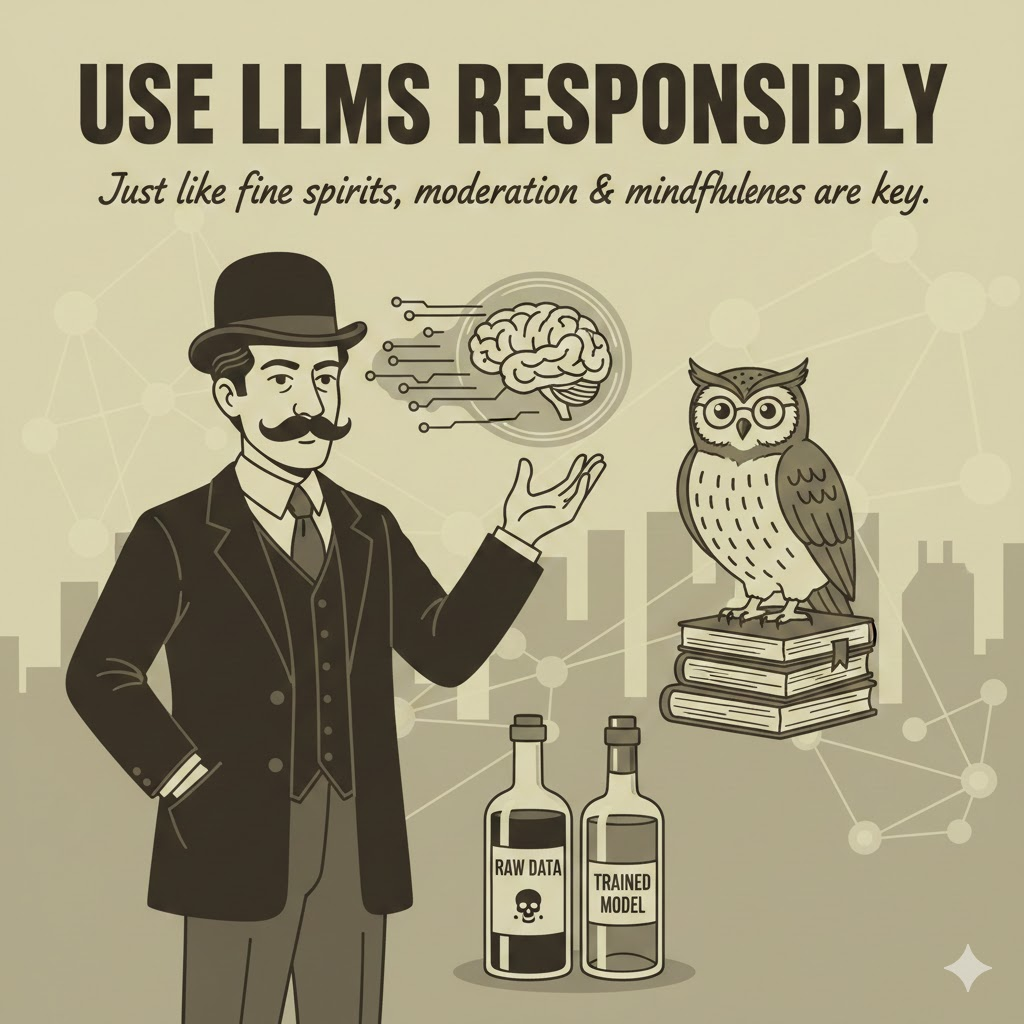
Note: both images are AI generated.
Member discussion